

Last week, one number reframed the Birkin conversation: $800 per month.
That is the starting price of Vivrelle Privée, the invite-only add-on tier from luxury accessories membership platform Vivrelle. The program gives approved members access to an ultra-curated closet that includes Hermès Birkin and Kelly bags, Van Cleef & Arpels, Bvlgari Serpenti pieces, and other high-end accessories. Members can borrow one Privée item at a time on a 30-day swap cycle, with VIP concierge support. Privée is not a standalone plan; it sits on top of an active Vivrelle membership, and Vivrelle's listed base plans currently start at $139 per month.
That means this is not a cheap shortcut to the Birkin. It is something more revealing: a new pricing model for proximity to status.

Editorial product visual: Pink Birkin bag. Photo by Yvette Religioso-Ilagan / Wikimedia Commons (CC BY 2.0).
For decades, the Birkin has been the ultimate ownership object. It is famous not only because it is expensive, but because it is difficult to access through traditional retail channels. Buyers have long obsessed over boutique relationships, spend history, resale premiums, condition, leather, hardware, size, color, and provenance. Now, rental platforms are asking a new question: what if the most valuable part of the Birkin is not permanent ownership, but temporary access to the cultural signal?
The Birkin is entering its access era: ownership still matters, but the market is beginning to price the signal separately from the asset.
The rental math: why $800/month is not as simple as it sounds
The economics are where this trend becomes especially interesting.
At $800 per month, Privée costs $9,600 per year before considering the required active Vivrelle membership underneath it. If a new member were on Vivrelle's lowest listed base tier, Classique at $139 per month, the annualized minimum access cost would be $11,268, assuming eligibility and before any taxes, fees, upgrades, shipping costs, or other membership-specific charges.
That is a significant luxury spend, but it is still below the current U.S. retail price of several core Birkin sizes. Sotheby's reported 2026 U.S. retail pricing for core leather Birkins at $13,500 for a Birkin 25, $14,900 for a Birkin 30, and $16,300 for a Birkin 35. Secondary-market pricing is much higher for the most desirable examples: Sotheby's notes that pristine Birkin 25 and Birkin 30 bags commonly trade around $28,000 to $30,000.
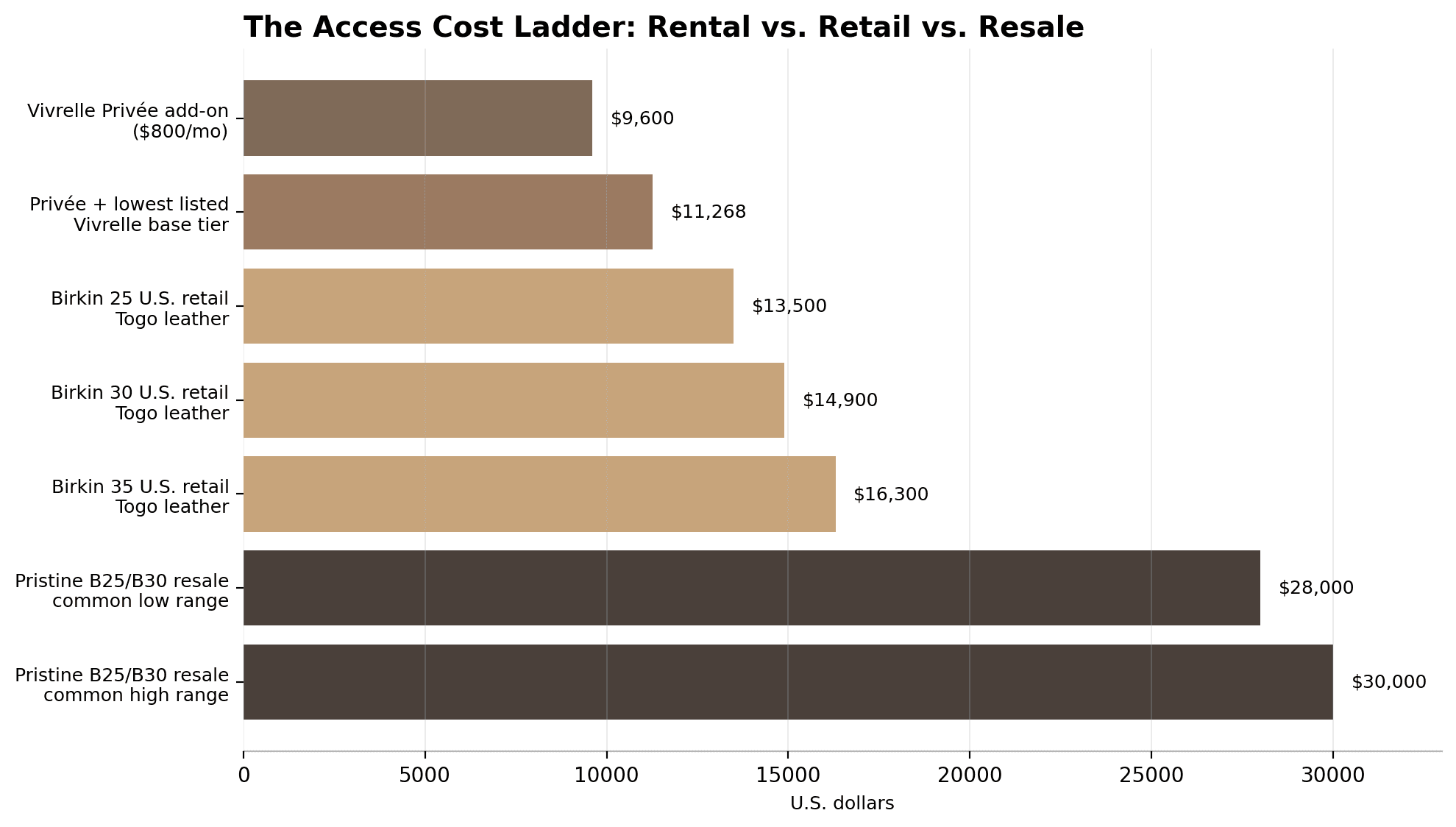
Annualized access cost compared with U.S. retail and common pristine resale ranges. Created in-house from Vivrelle and Sotheby's data.
The strategic read. Rental does not replace ownership. It monetizes the space between aspiration and acquisition. For the renter, the unit of value is not asset retention; it is rotation, event utility, styling flexibility, and social visibility.
High-fashion rental is maturing beyond occasion wear
Fashion rental used to be associated mainly with occasion dresses: weddings, galas, holiday parties, and one-time formalwear. The new high-fashion rental conversation is different. It is moving into the categories with the strongest luxury signaling power: handbags, watches, fine jewelry, and rare accessories.
Market data supports that shift. Custom Market Insights estimates the global fashion rental market at $2.47 billion in 2025, $2.84 billion in 2026, and $9.18 billion by 2035, implying a 12.4% CAGR from 2026 to 2035. The same report explicitly includes accessories and jewelry such as handbags, watches, fine jewelry, and scarves within the rental market scope.
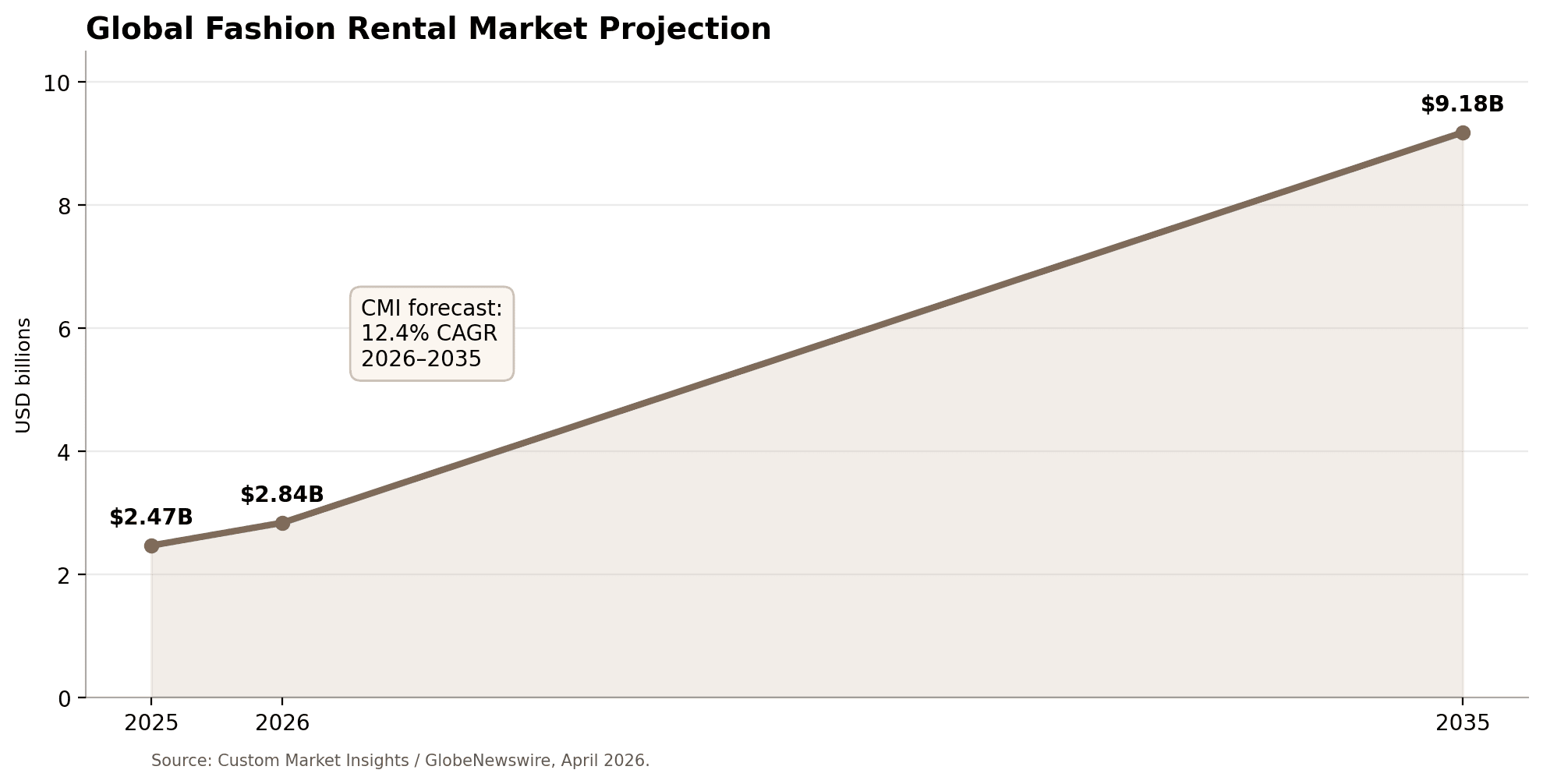
Global fashion rental market forecast. Created in-house from Custom Market Insights / GlobeNewswire data.
Rent the Runway's latest performance also suggests that subscription fashion is regaining commercial traction after years of skepticism around the model. The company reported Q4 fiscal 2025 revenue of $91.7 million, its highest quarterly revenue in company history, with revenue up 20% year over year and ending active subscribers up 20.1% year over year.
The Birkin's entrance into this rental conversation is important because it moves rental from “I need a dress for Saturday” into “I want access to the most protected luxury codes.” That is a very different consumer psychology. This is not just wardrobe convenience. It is status-as-a-service.
Why the Birkin is uniquely suited to access economics
The Birkin is the ideal object for this model because its value is built on scarcity, recognizability, and liquidity.
Hermès itself remains one of the most resilient names in luxury. In Q1 2026, the group reported consolidated revenue of €4.1 billion, up 5.6% at constant exchange rates. Leather Goods and Saddlery grew 9.4% at constant exchange rates, while the Americas rose 17.2%.
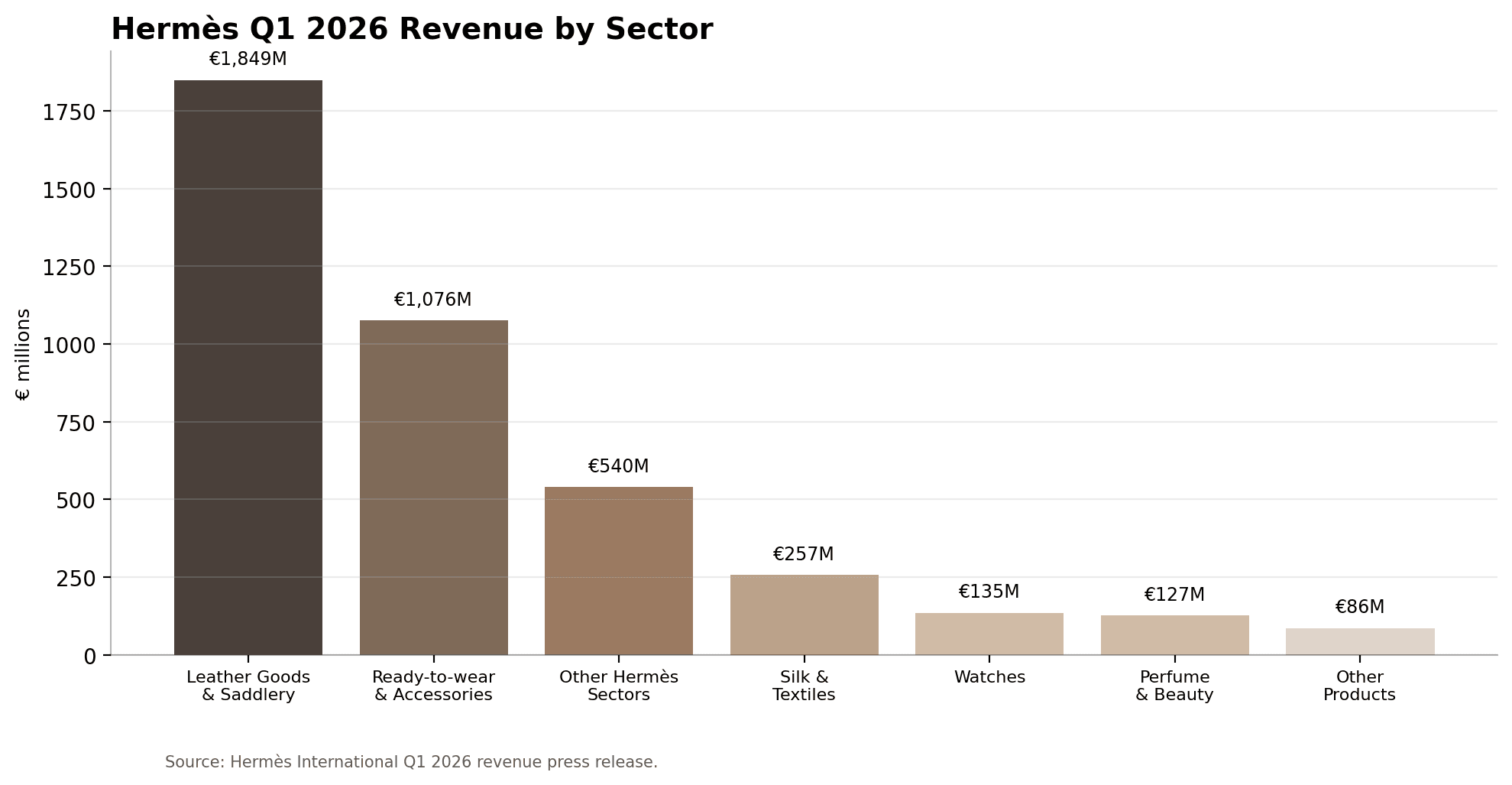
Hermès Q1 2026 revenue by sector. Created in-house from Hermès International revenue data.
The resale market reinforces this logic. The RealReal's 2025 Resale Report found that 47% of consumers now consider resale value before buying new, and listed the Hermès Birkin 30 among asset-like accessories whose resale values climbed in 2025, with Birkin 30 values up 15%.
Put simply, the Birkin is no longer just a handbag in the consumer imagination. It is a luxury object, a financialized collectible, a social-media prop, a status marker, and a resale benchmark. Rental platforms are not creating that value. They are extracting a new form of revenue from it.
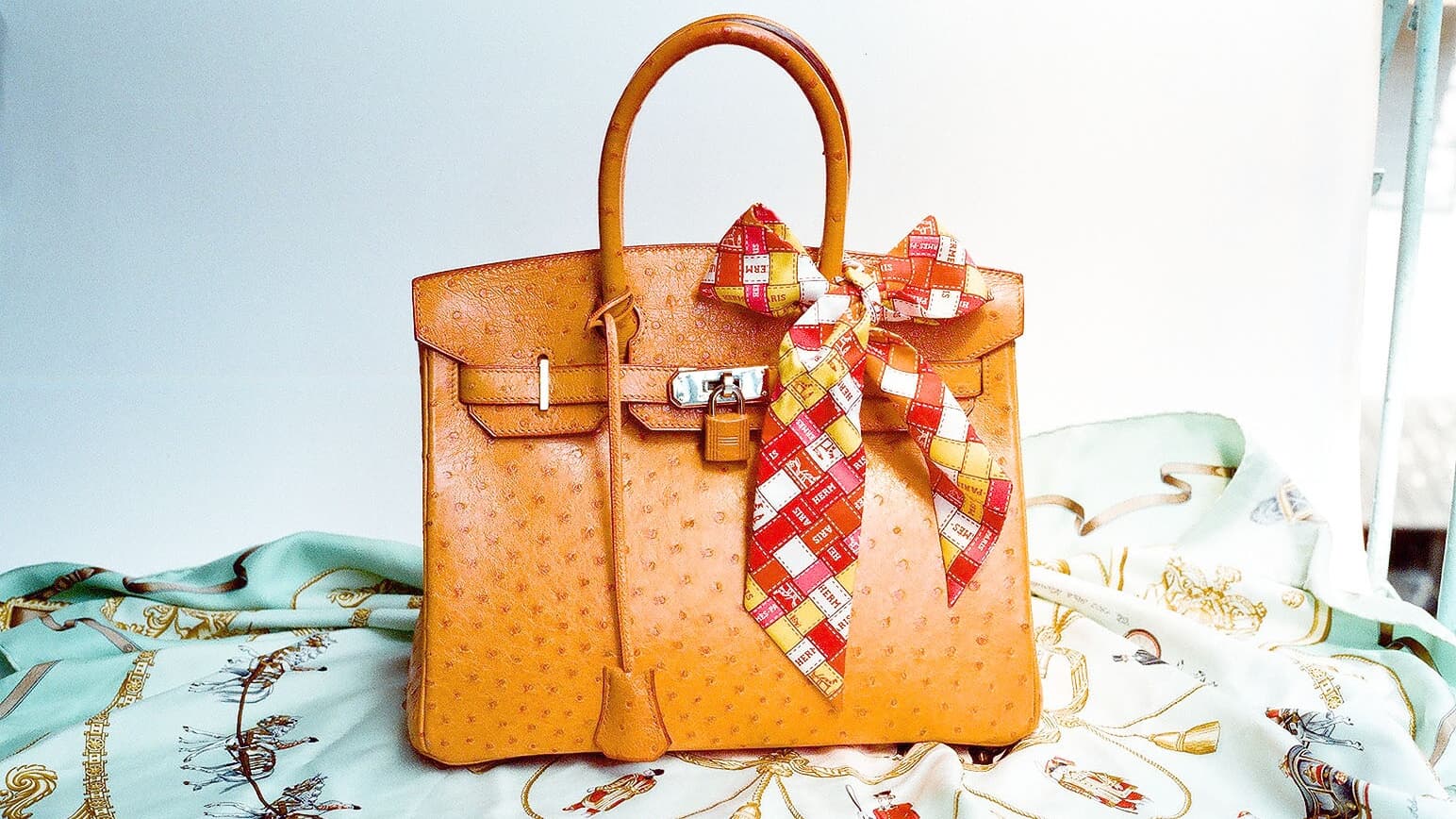
Product styling visual: Hermès ostrich Birkin with scarf. Photo by Wen-Cheng Liu / Wikimedia Commons (CC BY-SA 2.0).
The broader luxury context: experience is competing with possession
This shift also fits a broader pattern in luxury. Bain & Company and Altagamma reported that global luxury spending was broadly stable in 2025 at €1.44 trillion while consumers increasingly prioritized experiences over possessions. Bain also projected 4% to 6% annual growth for personal luxury goods to 2035, but emphasized a more discerning, experience-led luxury model.
That is the key to understanding Birkin rental. It is not anti-luxury. It is luxury behaving more like hospitality, travel, private clubs, and concierge culture.
Vivrelle Privée even mirrors that logic by pairing ultra-luxury item access with concierge service and lifestyle perks. Fashionista reported that members can rent Hermès Birkin, Kelly, and Constance bags, as well as rare jewelry and watches from houses including Van Cleef & Arpels, Bvlgari, and Cartier, with the ability to swap every 30 days or extend the rental period.
The contradiction: access is still exclusive
The most interesting part of the $800/month Birkin story is that it sounds democratizing but remains highly gated.
Privée is invite-only. Members must already belong to Vivrelle to be considered. The company states that Privée is available only as an add-on to an active membership.
So the story is not “everyone can rent a Birkin now.” The story is that a new class of high-fashion consumer can pay for controlled access without going through Hermès retail allocation or immediately paying resale-market premiums.
That distinction matters because the Birkin's traditional access model remains under scrutiny. A group of Hermès shoppers asked a U.S. appeals court in 2026 to reinstate a class-action lawsuit alleging that Hermès conditions access to Birkin bags on purchases of other Hermès products. Hermès has disputed the allegations, and a lower court dismissed the case, but the appeal kept the public conversation around Birkin access alive.
Rental platforms are stepping directly into that tension. They do not eliminate scarcity. They repackage scarcity into a membership product.
What this means for collectors, renters, and luxury brands
| Stakeholder | What they want | How rental changes the logic | Strategic implication |
|---|---|---|---|
| Collector | Asset retention, provenance, condition, rarity | Rental does not replace ownership; it may underline how valuable permanent possession remains. | Buy selectively: size, color, leather, condition and documentation still matter. |
| Renter | Event utility, social signal, rotation, styling options | The bag becomes an experience layer, not a capital allocation decision. | Best fit for high-event lifestyles, content production, or special-occasion dressing. |
| Rental platform | High-AOV memberships, retention, prestige inventory | Iconic accessories become recurring-revenue products. | Authentication, insurance, maintenance and inventory depth become competitive moats. |
| Luxury brand | Scarcity control, clienteling, brand halo | Third-party access channels grow outside the brand's own retail ecosystem. | Resale and rental may increase visibility while weakening direct control of access. |
For collectors, the access era may actually reinforce the value of ownership. If a rented Birkin costs nearly $10,000 a year before base membership considerations, then owning a pristine, desirable Birkin still carries asset logic. Buyers who can acquire the right size, leather, color, and condition may continue to see ownership as the stronger long-term move.
For renters, the value proposition is different. Rental offers flexibility, content utility, and optionality. A member can experience multiple styles without committing to one color or size. A stylist, founder, influencer, bride, executive, or frequent event attendee may get more use out of rotating access than a single purchase.
For luxury brands, the rise of rental is more complicated. On one hand, high-end rental keeps iconic products visible and culturally relevant. On the other, it allows consumers to experience brand codes outside the brand's own retail ecosystem.
The real trend: ownership is no longer the only luxury signal
The Birkin has always been about more than leather and hardware. It is about access, timing, cultural fluency, and belonging. What changed is that the market has started to separate those pieces.
- You can own the bag.
- You can rent the bag.
- You can photograph the bag.
- You can resell the bag.
- You can use the bag as a collectible asset.
- You can style it as a personal object.
- You can borrow its signal for 30 days.
That is why the $800/month conversation matters. It shows that luxury is not becoming less exclusive. It is becoming more modular.
The Birkin has not lost its aura. It has become a platform.
Sources and image credits
- Vivrelle Privée membership page.
- Fashionista — Hermès Birkin Bags Now Renting for $800/Month.
- Sotheby's — Higher Hermès Bag Prices in 2026: What You Need to Know.
- Hermès International — First Quarter Revenue 2026 press release.
- Custom Market Insights / GlobeNewswire — Global Fashion Rental Market Size and Share.
- Rent the Runway Investor Relations — Q4 and FY 2025 results.
- Bain & Company and Altagamma — Global luxury stays resilient in 2025.
- The RealReal — 2025 Resale Report.
- Reuters — Hermès buyers ask U.S. appeals court to reinstate Birkin handbag class action.
- Embedded image credits: Maison Hermès, Ginza by Basile Morin (Wikimedia Commons, CC BY-SA 4.0); Pink Birkin bag by Yvette Religioso-Ilagan (Wikimedia Commons, CC BY 2.0); Hermès ostrich Birkin by Wen-Cheng Liu (Wikimedia Commons, CC BY-SA 2.0).

