
If you went looking for Birkin coverage this week, you did not find one grand trend report. You found Easter eggs. One piece explained how to buy a Birkin online without getting burned. Another reminded everyone that a Birkin can still change the temperature of a celebrity sighting the moment it enters the frame. A third centered the kind of provenance that turns a famous bag into a true collectible. Taken together, this week's stories point in the same direction: in 2026, the Birkin is still aspirational, but the conversation around it is getting sharper, more practical, and more market-aware.
That shift matters because the broader luxury backdrop is no longer purely euphoric. Bain expects more measured growth in 2026 than the industry became used to during the post-pandemic luxury rush, while Hermès has continued to lift boutique prices on core leather Birkins. At the same time, the secondary market for the strongest Birkin configurations remains unusually resilient. Sotheby's continues to describe the Birkin 25 as the most sought-after standard size, and Rebag's latest retention data still places Hermès in rarefied territory. The result is a market that feels less like a wave and more like a ranking system. Demand is still there. It is just increasingly concentrated in the right sizes, colors, constructions, and stories.
The week the Birkin story got sharper
The clearest signal came from WWD's fresh guide to buying a Birkin online from trusted retailers. That framing is revealing. The older Birkin fantasy was built around boutique mystery, waiting lists, and access. The newer fantasy is increasingly about specification and verification. Buyers are learning to think in attributes: size, leather, color, condition, year, and seller credibility. In other words, the mainstream editorial conversation is beginning to catch up to the way the resale market already works. The Birkin still carries myth, but the modern buyer increasingly wants the myth translated into a checklist.
Harper's Bazaar approached the subject from the opposite direction. Its April 2 story on Lindsay Lohan photographed on the set of Count My Lies was not a market guide at all; it was a reminder that the Birkin still functions as immediate cultural shorthand. Lohan was seen carrying a mocha Birkin 35 Taurillon Clémence, and the piece noted that she has said she still carries the first Birkin she bought at eighteen, now reportedly filled with dinosaur toys for her son. That detail matters. It puts the Birkin back in the category that made it legendary in the first place: not simply a symbol of status, but a luxury object that can absorb daily life and still project aspiration.
That tension between cultural visibility and market efficiency is one of the most interesting things happening in 2026. Larger, softer Birkins still photograph beautifully and still dominate a lot of fashion imagery. But the collector market remains more concentrated around smaller, sharper, and cleaner examples, especially the Birkin 25. One Birkin keeps the dream alive. Another increasingly sets the premium.
Then there was the provenance story. Heritage Auctions previewed an April sale anchored by a 1997 Bleu Marine Courchevel Birkin 35 signed twice by Jane Birkin for Midori Senga, the proprietor of Tokyo's Agnes Hotel. PurseBop's follow-on discussion made the deeper point explicit: true Hermès collectibility is not always about the loudest leather or the rarest hardware. Sometimes it is about narrative density. The bag matters because it carries a friendship, inscriptions, and a human story inside the object itself. That is a useful reminder that the top end of this market is not priced by rarity alone. It is priced by story.
Spring colors are now a pricing story
The most useful Easter-week clue, though, may be the color story. Spring shades are no longer behaving like simple mood-board variations. In the current Birkin market, soft whites, pale pinks, and fresh greens increasingly sit inside the premium conversation rather than outside it. Sotheby's current valuation guidance says that recent releases in neutral or pastel colors tend to command the strongest prices, and its live marketplace backs that up with a wide spread of spring-adjacent examples that behave very differently depending on rarity, structure, and size.
Take the current visible asks. A Rose Sakura and Gris Perle Chèvre special-order HSS Birkin 30 is listed at $38,500. A Nata Epsom Sellier Birkin 30 is listed at $34,500. A Craie Togo Birkin 25 sits at $31,730. At the same time, a Vert Criquet Epsom Birkin 30 Sellier comes in at $18,850, while Rose Azalee HSS Birkin 30 examples sit lower still, in the low twenty-thousands. That is the key point. The market is not rewarding “spring color” as one generic category. It is rewarding the right spring color in the right format.
Pink remains the most instructive case. Sotheby's recent selling-strategies analysis highlighted how 5P Bubblegum Pink continues to operate like a collector color rather than a novelty shade, noting that a 5P Bubblegum Pink Birkin 30 in Epsom sold for $47,500 and that mini formats in the same tone have achieved even more dramatic results. In other words, pastel pink can behave less like seasonal charm and more like scarcity. Rose Sakura, 5P Bubblegum, and other pale Hermès pinks are not equal in the market, but the best of them can rival or surpass classic neutrals in the right condition and construction.
This is where the spring palette becomes analytically interesting. Nata and Craie behave like wearable white-adjacent neutrals — broad, elegant, highly liquid, and easy to understand. Rose Sakura carries the softness of a spring color but in a format the market reads as scarce and collectible. Vert Criquet feels more playful and less universally benchmarked, which helps explain why its visible asking levels can sit materially below the soft-whites and top pinks. The market is not simply asking whether a color is beautiful. It is asking whether that beauty is common, scarce, iconic, or configuration-sensitive.
Selected spring-color market snapshot
Current visible asks from referenced marketplace pages — close comparables, not direct like-for-like cross-color comps.
| Color | Current example | Visible ask | Reading |
|---|---|---|---|
| Rose Sakura | Rose Sakura / Gris Perle HSS Birkin 30, 2025 | $38,500 | Collector pink with special-order appeal |
| Nata | Nata Epsom Sellier Birkin 30, 2024 | $34,500 | Soft-white neutral with premium structure |
| Craie | Craie Togo Birkin 25, 2025 | $31,730 | Liquid pale neutral in the most desired size |
| 5P Bubblegum | Gris Tourterelle / 5P Bubblegum HSS Birkin 25, 2012 | $24,000 | Color signal remains strong, but format matters |
| Vert Criquet | Vert Criquet Epsom Birkin 30 Sellier, 2020 | $18,850 | Playful spring green priced below the top pastel tier |
That is why a light Easter metaphor actually fits the Birkin surprisingly well this spring. The modern Birkin market feels like a luxury egg hunt. The clues are scattered. Some are obvious: retail hikes, sustained demand for Birkin 25s, and the continued premium attached to pristine condition. Others are subtler: a celebrity carrying a larger, more relaxed Birkin that reminds the culture why the silhouette still matters; a signed bag that proves provenance can eclipse surface-level rarity; a spring color palette that looks decorative at first glance but turns out to be highly stratified by demand.
The prize is no longer just the bag itself. The real prize is the ability to read what kind of Birkin you are actually looking at. For Bespoke Bazaar, that may be the clearest signal of all. The next phase of the Birkin conversation will not be won by repeating the myth louder. It will be won by decoding it better.
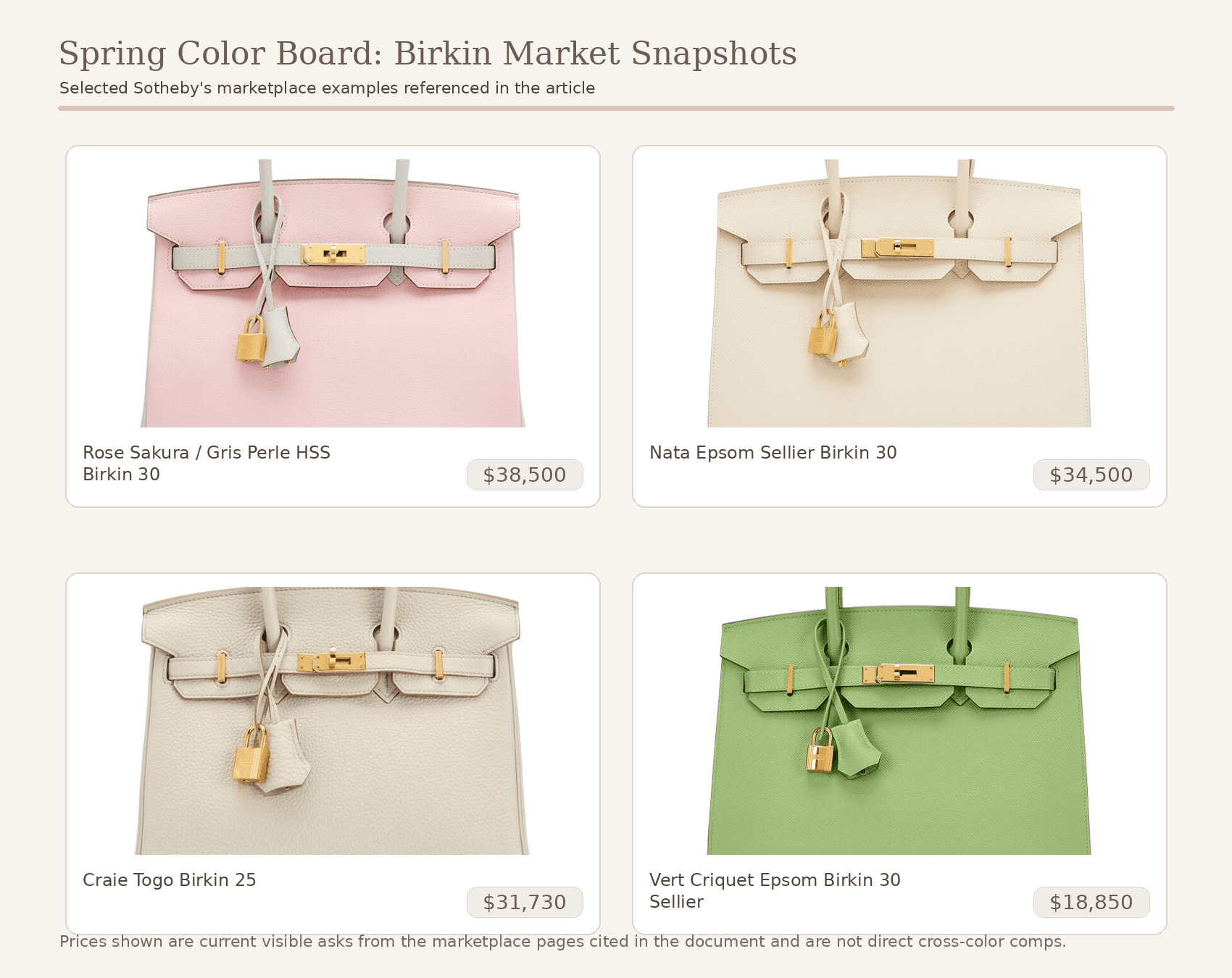
Figure: spring-color examples referenced in the article. Images from current Sotheby's marketplace pages.

